
Advantages
The welding industry is experiencing a thrilling technological advancement with the introduction of welding robots. It's a time filled with anticipation for the industry as robotic welders continue to progress and accommodate a wider range of welding procedures. Are you intrigued by welding robots and interested in learning more about their capabilities?
Let's dive straight into it!
Manual Welding vs. Robotic Welding
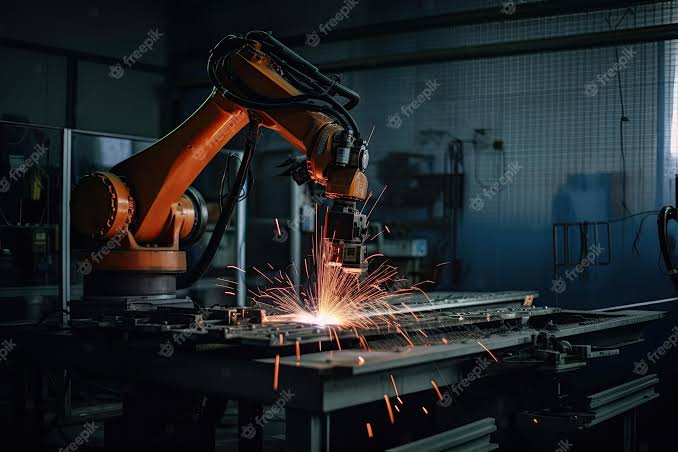
Robotic welding involves the use of a welding robot arm to automate the welding process. As the name suggests, the robot arm moves the welding torch along the joint to fuse the pieces together. With the help of advanced welding tools, robotic welders have become capable of performing various welding processes.
There are two primary types of robotic welding: automatic and semi-automatic.
In an automatic robotic welding system, the parts are supplied either through a conveyor or a magazine. These parts are then clamped in position for the robot to commence the welding process. Once the welding is complete, operators transfer the welded pieces to subsequent operations such as inspection, assembly, or packaging.
In a semi-automatic robotic welding system, an operator enters the robot cell to remove the finished weld. The operator then positions the next set of pieces for the robot to weld.
Compared to manual welding, robotic welding offers increased speed and productivity. This is mainly due to the fact that robots do not require breaks like human welders. Additionally, the cost per welded piece decreases as robotic welders can produce a larger number of welded parts compared to their human counterparts.
The Rise of Robotic Weilding
While you may assume that welding robots are a recent innovation, they have actually been in existence for over six decades. Let's briefly explore the evolution of robot welding.
In 1954, George Devol invented the first programmable robot, which eventually led to the creation of the world's inaugural industrial robot. Devol went on to establish Unimation, the first robot company, where he and his colleagues developed the pioneering industrial robot known as Unimate. Unimate found its place in the General Motors (GM) Automobile factory in New Jersey, where it carried out spot welding and extracted die castings. The positive reception following the initial trial propelled the global popularity of welding robots.
In 1978, backed by GM's support, Unimation introduced the Programmable Universal Machine for Assembly (PUMA), a versatile machine that remains in use to this day.
The 1980s witnessed substantial growth in the industrial robot industry, with new robotic welding machines emerging on a monthly basis. This decade also marked advancements in robotic arm mobility and control.
Since then, robot designs have consistently improved. Robotic interfaces have undergone enhancements, resulting in streamlined and simplified designs. Operator interfaces have also been upgraded to facilitate easier maintenance and repair.
Following the industrial robots, smaller collaborative robots (Cobots) were introduced to work alongside humans. Cobots are characterized by their ease of programming and enhanced safety compared to their industrial counterparts.
The development of welding cobots continues, and it remains uncertain what future advancements lie ahead.
Advantages of Weilding Robots
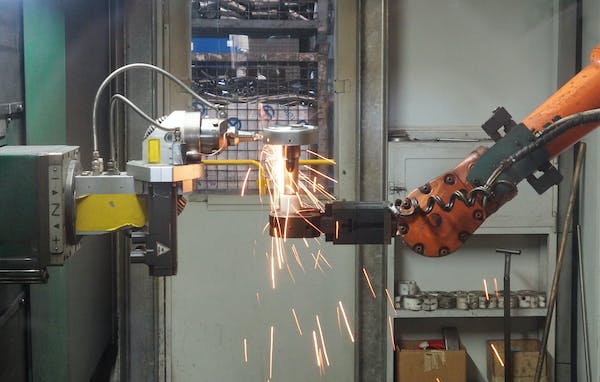
Let's explore several key benefits of incorporating a robotic welder into your operations:
Increased Productivity:
Robotic welders exhibit enhanced speed and efficiency, outperforming their human counterparts. They demonstrate remarkable accuracy and precision, resulting in fewer errors. With efficiency rates of up to 85%, robotic welders surpass the average 20% efficiency achieved by skilled human welders.
Unlike humans, robots do not experience fatigue, require breaks, or take vacations. They consistently deliver the same level of quality welds day in and day out. While human welders may have less than 50% arc-on time, this figure can significantly decrease as fatigue sets in. In contrast, robotic welders can maintain an arc-on time of up to 95%.
Enhanced and Constant Quality
Robotic welders are impervious to distractions, allowing them to maintain consistent weld speed, current, and other critical variables. As a result, they consistently achieve high-quality welds with precision and repeatability. This makes them particularly suitable for welding projects that demand stringent quality requirements.
Reduced Waste and Consumables
By minimizing welding errors associated with human welders, robotic welders significantly reduce waste. Their tireless performance eliminates the impact of fatigue-related issues. Consistently producing high-quality welds helps avoid material scraps, enabling better adherence to budgets, especially for high-value projects.
Robotic welders demonstrate efficient utilization of consumables, such as fillers, leading to reduced waste. They optimize the usage of nozzles, prolonging their lifespan and minimizing the frequency of replacement. These factors contribute to cost savings as consumables are purchased less frequently.
The need to use weilding robots:
In industries that demand high production rates, robotic welding is widely employed. Spot welding, a commonly utilized technique in the automotive sector, stands out as a prevalent application for welding robots. However, there is a growing trend towards the use of welding robots in arc welding processes as well.
Different Welding Robots In The Market
Within the market, numerous brands of robotic welders are available. However, for the purpose of this article, let's focus on the different types of robots based on the welding processes they employ.
Resistance Spot Welding Robots:
Resistance spot welding is commonly used in the automotive manufacturing industry. This process utilizes high electrical currents to join multiple sheets of metal in a single location. Spot welding robots are typically articulated robots with rotary joints, offering a range of two to ten axes. Equipped with a servo motor and a high-resolution encoder, these robots precisely control the motion of the spot welding gun. The welding gun features a pair of electrodes that can open and close, while specialized software governs the robotic arm's acceleration, position, and force.
Collaborative Welding Robots:
Collaborative robot welding, often referred to as cobot welding, involves the use of a robotic arm, typically with six axes, fitted with a welding torch as its end effector. Unlike traditional industrial robots, cobots have the ability to work alongside humans, eliminating the need for separate robot cells. They require minimal safety measures related to welding (e.g., flash and splatter) and can be easily deployed and redeployed for various tasks. The Cobot Welder by Hirebotics stands out as one of the simplest cobots to program, allowing welders to teach the robot using their phone and an accompanying app.
Shielded Metal Arc Welding Robots (SMAW):
Shielded Metal Arc Welding, also known as SMAW or stick welding, utilizes a consumable electrode covered in flux to create an electric arc for welding. While not as commonly automated as other processes, robotic SMAW systems do exist and can perform various welding tasks.
Robotic Gas Metal Arc Welding (GMAW/MIG):
Robotic Gas Metal Arc Welding, also known as GMAW or MIG welding, employs a continuously fed consumable wire electrode and a shielding gas to produce a weld. It is a widely used and versatile welding process that can be effectively automated using welding robots.
Robotic Gas Tungsten Arc Welding (GTAW/TIG):
Robotic Gas Tungsten Arc Welding, also known as GTAW or TIG welding, utilizes a non-consumable tungsten electrode and an inert gas shield to create the weld. This precise and high-quality welding process is suitable for various materials and can be successfully automated with welding robots.
Robot Laser Welding:
Robot laser welding utilizes a high-energy laser beam to join metal components. This process offers fast and precise welding capabilities, often used in industries that require high accuracy and minimal heat-affected zones.
Plasma Welding Robot:
Plasma welding involves the use of a highly concentrated plasma arc to melt and join metals. While less common in robotic welding applications, plasma welding robots can be utilized for specialized welding tasks.
The diverse range of welding robot types encompasses resistance spot welding robots, collaborative welding robots, SMAW robots, GMAW/MIG robots, GTAW/TIG robots, robot laser welding, and plasma welding robots. Each type caters to specific welding processes and offers unique advantages in terms of efficiency, precision, and flexibility.
The Evolving Weilding industry
The welding industry is undergoing continuous transformation, driven by advancements in robot welding and cobot welding. These innovations enable not only large enterprises but also small and medium-sized welding businesses to leverage the benefits of automation. This dynamic landscape brings forth an exhilarating era for the welding industry!
.png)


